A Google Ads campaign is not only earned from settings, keywords and budget. These are important, but in many projects the real problem occurs after the click: the user lands on a page that doesn't explain clearly enough why they should request a quote, doesn't respond to objections, and doesn't take the next simple step.
That's why, for B2B services, local companies, construction, consulting, medical services, automotive, beauty or specialized e-commerce, the landing page is the piece that connects paid traffic to sales. If the page is weak, you pay for clicks. If the page is thought out correctly, you start buying real opportunities.
Why it's not enough to send traffic to your homepage
The homepage usually has several roles: it presents the company, the services, the portfolio, the story, the contact and sometimes the blog. For a visitor coming from Google Ads, this variety can become noise. The person searched for something specific, clicked on a specific ad, and expects a page that continues the conversation started in the ad.
A good landing page reduces unnecessary decisions. It doesn't force the visitor to look up where the offer is, what they're getting, or how they can contact you. It quickly shows him that he has reached the right place and directs him to a form, a call or a consultation request.
The message above must confirm the intent from the search
The first section is decisive. In the first few seconds, the visitor needs to understand three things: what you are offering, who it is suitable for and what result you are aiming for. If the ad promises "business showcase creation", the page should not start generically with "Innovative Digital Solutions". They should speak directly about sites that bring trust, requests for quotation and a clear presentation of services.
The simple formula is: problem + solution + result. For example: "Landing pages for Google Ads that convert paid traffic into measurable bid requests." It is specific, easy to understand and prepares the visitor for action.
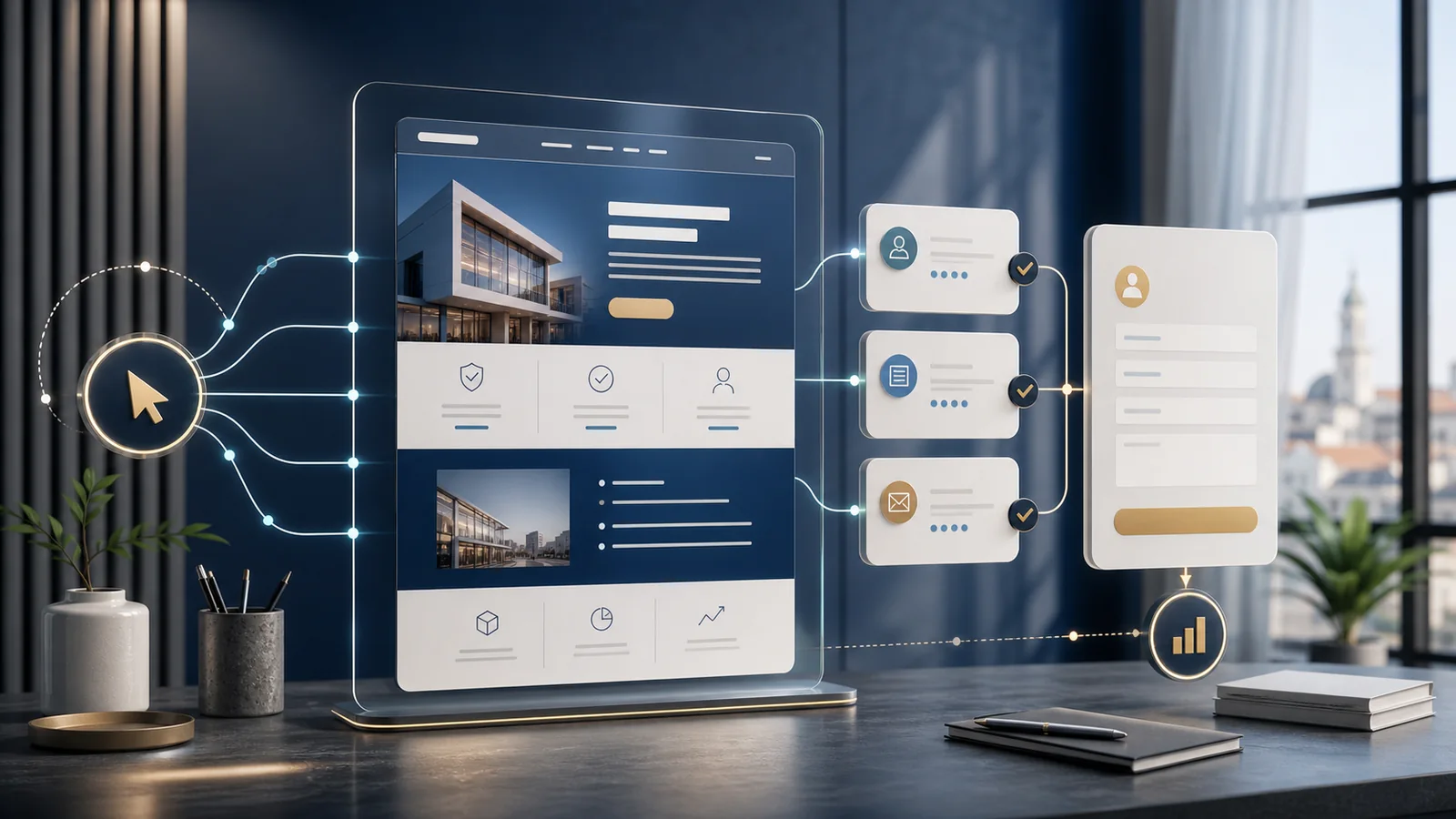
Recommended structure for a page that converts
There is no single perfect structure, but there is a logic that we frequently use in Docodex projects. The goal is to answer the questions in the order they appear in the customer's mind.
- Hero clearly: specific headline, result-oriented subheading and a visible CTA.
- Customer Problem: explains why paid traffic is lost without a dedicated page.
- What the customer gets: concrete deliverables, not vague promises.
- Evidence: portfolio, results, testimonials, processes or work examples.
- Process: the steps from brief to launch and optimization.
- Short form: few, clear fields with trust message next to button.
- Frequently Asked Questions: price, duration, maintenance, tracking, integration with CRM or email.
The form should only ask for the necessary information
A long form may look professional, but it often reduces conversions. For the first application, you need enough information to qualify the lead, not a complete file. Name, email, telephone, desired service, indicative budget and message are usually sufficient.
If you need additional details, you can ask for them after the first contact. The important thing is that the user does not feel that they have to work too hard to start the conversation. A good form is clear, friendly, and explains what happens after submission: "We'll get back to you within 24-48 hours with questions, recommendations, and next steps."
Page speed directly influences campaign cost
Google Ads doesn't just analyze the ad. Landing page experience influences Quality Score, and Quality Score can influence cost per click and ad position. A slow, cluttered or hard-to-use page on the phone can make the campaign more expensive without it being obvious at first.
In practice, the most important optimizations are: compressed images, CSS and JavaScript loaded only where needed, fast form, stable layout and a mobile version that does not force the user to look for the CTA. If the majority of clicks come from the phone, the page must be designed mobile-first.
Tracking must be set up before you start the budget
Without tracking, you don't know which ad, keyword or audience is producing real requests. You need at least form submit, phone click, email click and page view events. Ideally, leads should keep their UTMs, source and campaign so you can see what's worth scaling.
A good landing page for Google Ads is not just design. It is a combination of message, technical, analysis and selling. If you only measure clicks, you're optimizing for traffic. If you measure requests and their quality, you optimize for business.
Common mistakes that decrease conversion
- Too general message: the page does not follow through on the promise in the ad.
- Too many options: the visitor can go to other pages before requesting the offer.
- No proof: there is no portfolio, examples, testimonials or clear arguments.
- Form too long: asking for too many details too soon.
- Hidden CTA: the main button doesn't appear fast enough on mobile.
- No clear follow-up: the user does not know when he receives a response and what comes next.
Quick checklist before you launch your campaign
- Check if the title of the page matches the intent of the keywords.
- Make sure the page loads quickly on mobile.
- Put the main CTA prominently in the first section and repeat it naturally on the page.
- Include proof: projects, results, testimonials or clear process.
- Test the form, confirmation emails and thank you page.
- Check events in GA4/GTM before consuming budget.
- Look at lead quality, not just the number of conversions.
When is it worth building a dedicated landing page?
If you're constantly investing in Google Ads or want to test an important offer, a dedicated page is almost always worth it. It is especially useful when you have high-value services, longer purchase decisions, strong competition, or multiple types of customers.
Instead of sending all your campaigns to the same page, you can build different pages for services, industries or geographies. This allows you to be more relevant, test messages and see more clearly what brings good requests.
Conclusion
A landing page for Google Ads is not just a pretty page. It's the campaign conversion infrastructure. When message, form, speed, tracking and proof work together, budget becomes easier to control and leads become clearer.
If you want to run Google Ads campaigns with a page built for conversions, Docodex can help you with strategy, design, development, tracking and post-launch optimization.