Custom e-commerce platform
Multiple merchants or organizations, roles, approvals, pricing rules, repositories and integrations built for the business model.
Explore custom platforms →
Docodex - websites, applications and digital systems for business.
Custom commercial systems
We build marketplaces, B2B portals and multi-vendor systems around roles, business rules, data and real integrations.
Custom platforms do not use a generic implementation price. Discovery and specifications are offered separately, and development is estimated after clarifying modules, roles, integrations and infrastructure.
Choosing the right solution
We separate the two services so that the architecture, budget and workflow starts from the real complexity.
Multiple merchants or organizations, roles, approvals, pricing rules, repositories and integrations built for the business model.
Explore custom platforms →Catalog, cart, checkout, payments, delivery and order management for a company that sells its products.
See the Online Shop service →Positioning
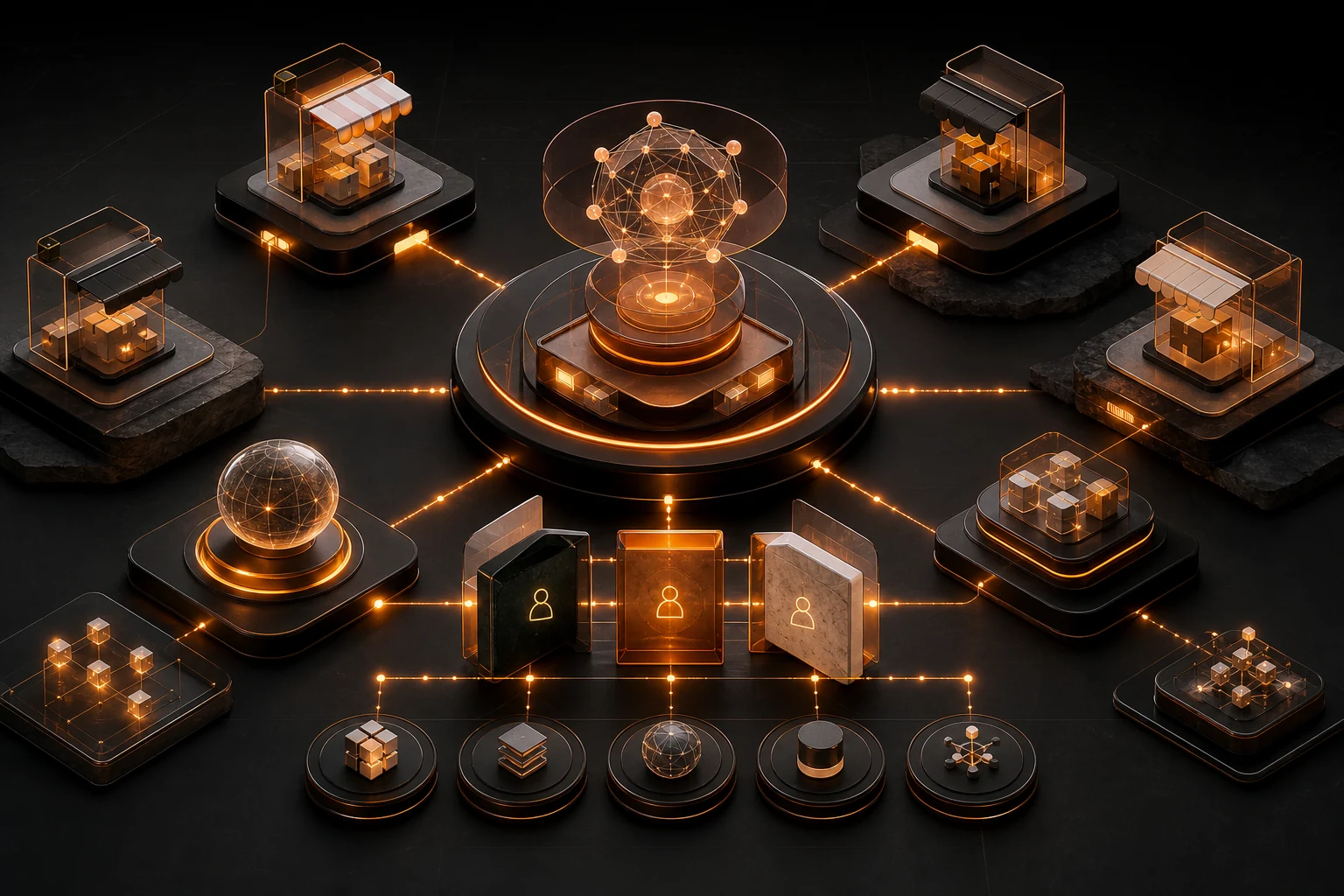
A custom platform does not start from a list of extensions. We start with actors, processes, exceptions, data sources, and operational responsibilities.
We define what needs to be automated, what remains under human control and how information flows between customers, merchants, internal teams and external systems.
The rules differ between customers, traders or markets, and orders depend on approvals, stocks, prices and systems that need to be coordinated.
Organizations, agents, merchants and administrators have distinct rights and paths.
Our answer: we model permissions and states before development.
Products, stocks, prices and orders are shared between systems.
Our answer: we establish the source of truth and the timing mechanisms.
Approvals, limits and trade rules are time-consuming and error-prone.
Our answer: we automate predictable cases and keep control where it counts.
Any new integration affects existing flows.
Our answer: we separate modules and define clear contracts between components.
Who is it suitable for?
The service is appropriate when business advantage or efficiency directly depends on commercial software.
Types of solutions
The platform type is just the starting point. The final modules are defined by specifications and priorities.
It includes merchants, catalogs and commissions.Onboarding, moderation, orders and reports.
It includes companies, users and price lists.Approvals, limits, bidding and recurring orders.
It includes territories, agents and warehouses.Inventory, trade rules and ERP integration.
It includes rules, validations and calculations.Bid, document and approval flows.
Features and deliverables
Each module is included only if it appears in the specification and offer.
Architecture and Technology
The architecture is established by volumes, roles, availability, and systems that remain the source of truth.
Concrete scenarios
Distinct organizations, users, limits, approvals, and catalogs.
Onboarding, moderation, commissions, settlements and reporting.
Controlled synchronized products, stocks, orders and statuses.
Work process
Responsible estimation
We do not promise a fixed price until we understand the roles, rules, data volumes, integrations and availability requirements.
Custom platforms do not use standard packages with assumed functionality. Each stage receives deliverables, criteria and estimate after project clarification.
To delineate the business model and prepare a responsible estimate.
For the first usable version, bounded by flows and acceptance criteria.
For complex platforms that need to be expanded without disrupting current operation.
Discovery does not automatically include development. Its value is deduced from the implementation only if this is explicitly provided in the offer. Hosting, licenses and external services are separate.
Operation after launch
The initial stabilization covers the delivered functionality. Operation, monitoring and further development are planned separately.
Marketplace and B2B
Integrations and Automations
Maintenance and expansion

It is a commercial system built around processes, roles and rules that go beyond the model of a classic online store: marketplace, B2B portal, multi-vendor, approvals, negotiated prices or integration with internal systems.
In an online store, a merchant sells his own products. A custom platform can serve multiple merchants, organizations, warehouses, price lists, approvals and different trade flows.
Yes, after clarifying the operating model. Merchant onboarding, catalogs, commissions, payments, moderation, returns, reports, and each party's responsibilities must be defined.
Yes. The platform can include organizations, multiple users, negotiated pricing, limits, approvals, RFQs, recurring orders, and ERP integration, depending on the project specification.
Yes, if the systems provide compatible APIs, exports, or other mechanisms. Compatibility, data quality and integration limits are checked before bidding.
Yes. Allocation, reservation, timing and availability rules must be defined along with the actual stock source and failure scenarios.
The estimation is done after the analysis and specification stage. Cost depends on roles, modules, business rules, data, integrations, infrastructure, security and reporting requirements.
We do not use a standard package for custom platforms. We can start with a paid discovery and specification stage, followed by a staged offer for implementation.
Duration is determined after clarifying modules and dependencies. Custom platforms are usually delivered in stages, with intermediate validations and controlled releases.
Yes. We define the functions required to validate the business model and clearly separate the components that can be developed after the initial release.
The rights to the custom code, the repository, the reusable components, the infrastructure and the transfer conditions are explicitly specified in the offer and the contract.
Not by default. VPS, storage, email, SMS, payment processors, licenses and other recurring services are priced separately.
We define authentication, role-based authorization, action auditing, data protection, backup and monitoring based on project risk and infrastructure.
Yes, after an audit of the code, infrastructure, dependencies, data and documentation. The audit determines whether it is safer to continue, refactor, or staged rebuild.
Yes. Monitoring, backup, updates, operational support and development of new modules are covered by a separate maintenance and continuous development agreement.
Next step
We start with actors, rules, data, and integrations. Then we establish an architecture, an MVP and the implementation stages.