
API
The controlled interface through which systems exchange data
Endpoints, authentication, validation, responses and rules for access.

Docodex - websites, applications and digital systems for business.
Connected systems and controlled data
We develop APIs and integrations that connect applications, services and partners with clear rules for data, errors and monitoring.
Indicative price for a small and well-defined integration. Multiple systems, two-way synchronization, high volumes, and complex processing are priced separately.
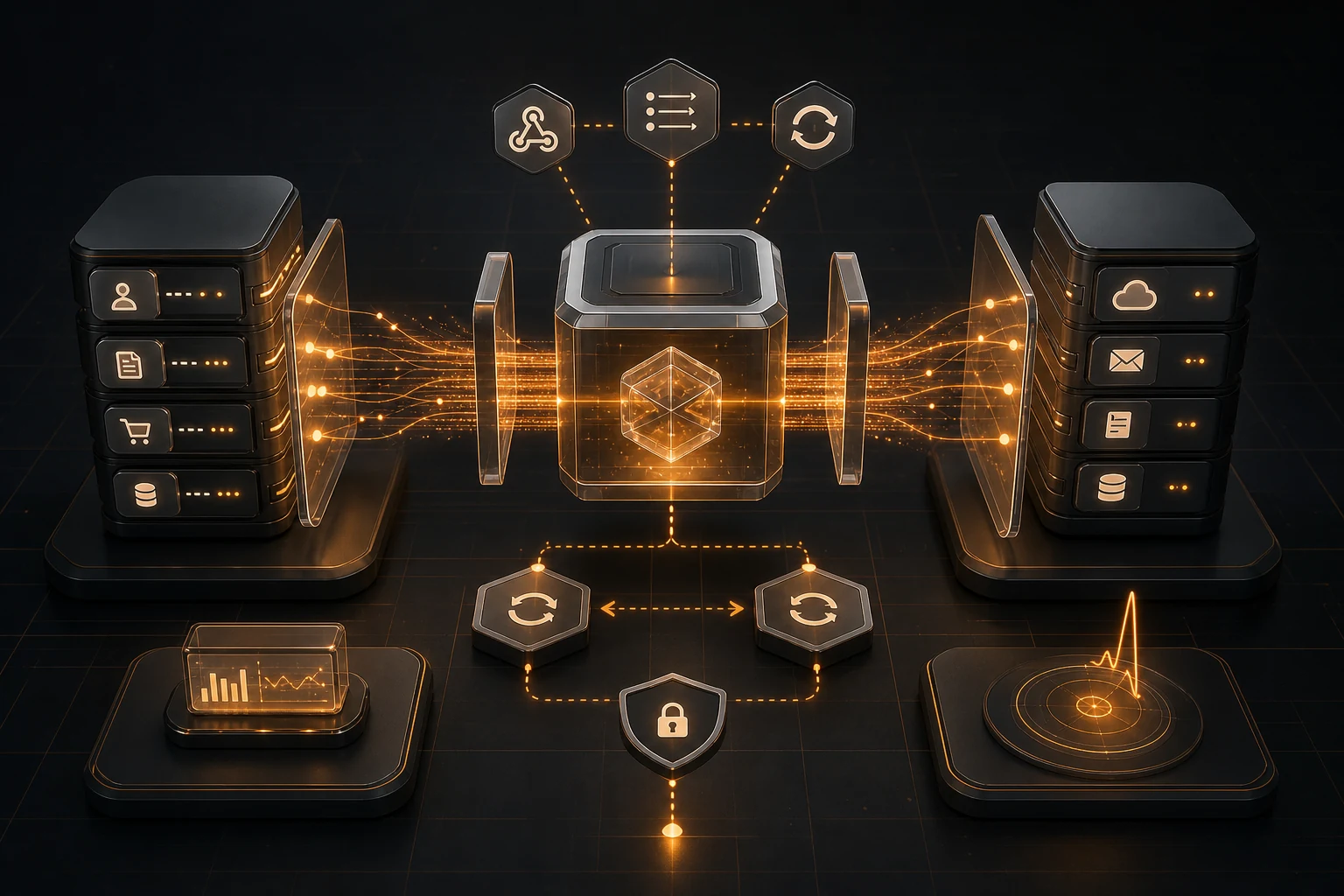
Connected systems
When customer, order, billing, payment and document systems don't communicate, the team enters the same information multiple times.
We develop APIs and integrations that transfer data in a controlled manner and automate invoices, statuses, notifications, imports and synchronizations, within the limits of access provided by external platforms.
Clarification
Endpoints, authentication, validation, responses and rules for access.
Data mapping, transformations, synchronization, and handling cross-platform differences.
Scheduled tasks, webhooks, notifications, documents and status updates.
Technical flow
Comandă, client, plată sau document.
Authentication, Mapping and Rules.
Webhook, queue, retry or task.
Status, invoice, AWB or notification.
The exact flow depends on the capabilities and limitations of each system. Not every platform can be integrated.
We map the data path, eliminate repetitive steps, and build mechanisms for situations where external services have little or no response.
The same information is entered into CRM, billing, store and reports.
The systems show conflicting values and no one knows the correct source.
Failed processing has no logging, retry, alert, or reconciliation procedure.
Every new system requires manual interventions and improvised rules.
Suitable for
It is suitable when there is a clear flow, legal technical access and a measurable result.
When it's not appropriate
We cannot promise platform integration without API, permitted access, or vendor collaboration. We do not implement unauthorized access and do not expose scraping as an API.
Check feasibilityTypes of projects
Backend for web, mobile or partners.
Confirmations, documents, AWB and statuses.
Leads, customers, products, inventory and orders.
CSV, Excel, API or scheduled files.
Controlled processing of external actions.
Audit, refactor, retry and monitor.
Features and deliverables
Components are selected after documentation, flow and risk analysis.
Architecture
We build it for the project's data, permissions, and consumers.
We depend on documentation, versions, limits, costs and availability.
Suitable when the supplier transmits the changes immediately.
Suitable for volumes, reports and systems without webhooks.
Mechanisms
The external system broadcasts the event when it occurs.
The integration periodically checks for new or changed data.
Processing runs at defined times or intervals.
The operation is queued for execution and controlled retry.
Commercial integrations
The customer owns the merchant account, the contract and bears the commissions.
The setup and accounting rules are confirmed by the client and the accountant.
Commercial agreement and access belong to the customer.
ERP projects frequently require sandboxing and external technical collaboration.
Initial analysis
The audit can be estimated separately and become the basis of project specifications.
Process
Reliability and security
External services, network and data can cause errors. We do not promise absolute functionality; we build control and recovery mechanisms.
We limit attempts, record status and alert when processing cannot be completed.
Foreign Identifiers, Idempotent Keys, Transactions, and Database Constraints.
HTTPS, authentication, authorization, validation, key rotation and logs without sensitive data.
The final offer is determined after analyzing the systems, documentation and flow.
For a limited API or clear integration between two systems.
For multiple streams, synchronization and controlled error handling.
For multiple critical systems, volumes and processes.
Costs of external services, licenses, accounts, API traffic and infrastructure are not included unless the offer states otherwise.
We first check systems, documentation and flow.
| Appearance | Integration Start | Automation Growth | Integration Platform Business |
|---|---|---|---|
| Price | From €990 + VAT | From €2,490 + VAT | From €5,990 + VAT |
| Systems | 2 | 2–3 | Multiple |
| Webhooks | Limited | Yes | Multiple |
| Asynchronous processing | Not by default | Yes | Advanced |
| Logging | Basic | Extended | Centralized |
| Monitoring | Not by default | Basic | Advanced |
| Stabilization | 30 days | 45 days | 60 days |
| Term | 10–25 days | 25–55 days | 50–120+ days |
Estimate and Responsibilities
The customer provides documentation, accounts, sandbox access, test data, validated rules, and a committer.
Keys, tokens and passwords are not submitted via the form; they are later transmitted through a secure channel.
After launch
Providers may change APIs, authentication, limits or conditions. Monitoring, adaptations and new developments are separate stabilization services.
Technology
We choose the mechanism according to the volume, frequency, risks, costs and capabilities of the systems involved.














Portfolio
Already have an integration?
We check code, documentation, logs, credentials, bugs, duplicates, and systems involved before estimating.
Tell us about systems, data and process. Do not submit passwords, tokens or API keys through the form.
A small and well-defined integration starts at €990 + VAT. The final cost depends on systems, documentation, data direction, volume and error handling.
An API is the controlled interface through which applications request, send, and update data.
Yes. We can develop backends, endpoints, authentication, permissions, validation, versions and documentation.
Yes, if the systems provide appropriate legal and technical access. Feasibility is checked before bidding.
We analyze exports, imports or scheduled files. We don't use unauthorized access and we don't present scraping as an official integration.
It can work in near real time via webhooks if the provider allows; otherwise we use polling or scheduled tasks.
Depending on the risk, we implement logging, retry, backoff, idempotency, alerts and reconciliation.
Yes, through sandbox or staging when the provider offers them.
Yes. The level of documentation is set in the offering and may include endpoints, authentication, examples, and errors.
Yes, after an evaluation of the code, documentation, logs and systems involved.
Customer supports licenses, API traffic, and external subscriptions unless the offer states otherwise.
Yes. Initial stabilization is separate from ongoing monitoring and maintenance.
Next step
Tell us what apps you use, what data needs to be transferred and what operation you want to automate. We check the feasibility and propose a clear technical flow.
 LawyerAlert
 E-commerce integrations
 Business automations