
Manually copied data
Information is moved between Excel, email, CRM and other applications.

Docodex - websites, applications and digital systems for business.
Simpler processes and more control
We transform repetitive activities into automated flows that reduce work time and the risk of error.
Indicative price for a repetitive, clear and well-defined process. The number of stages, systems, exceptions and volumes may change the estimate.
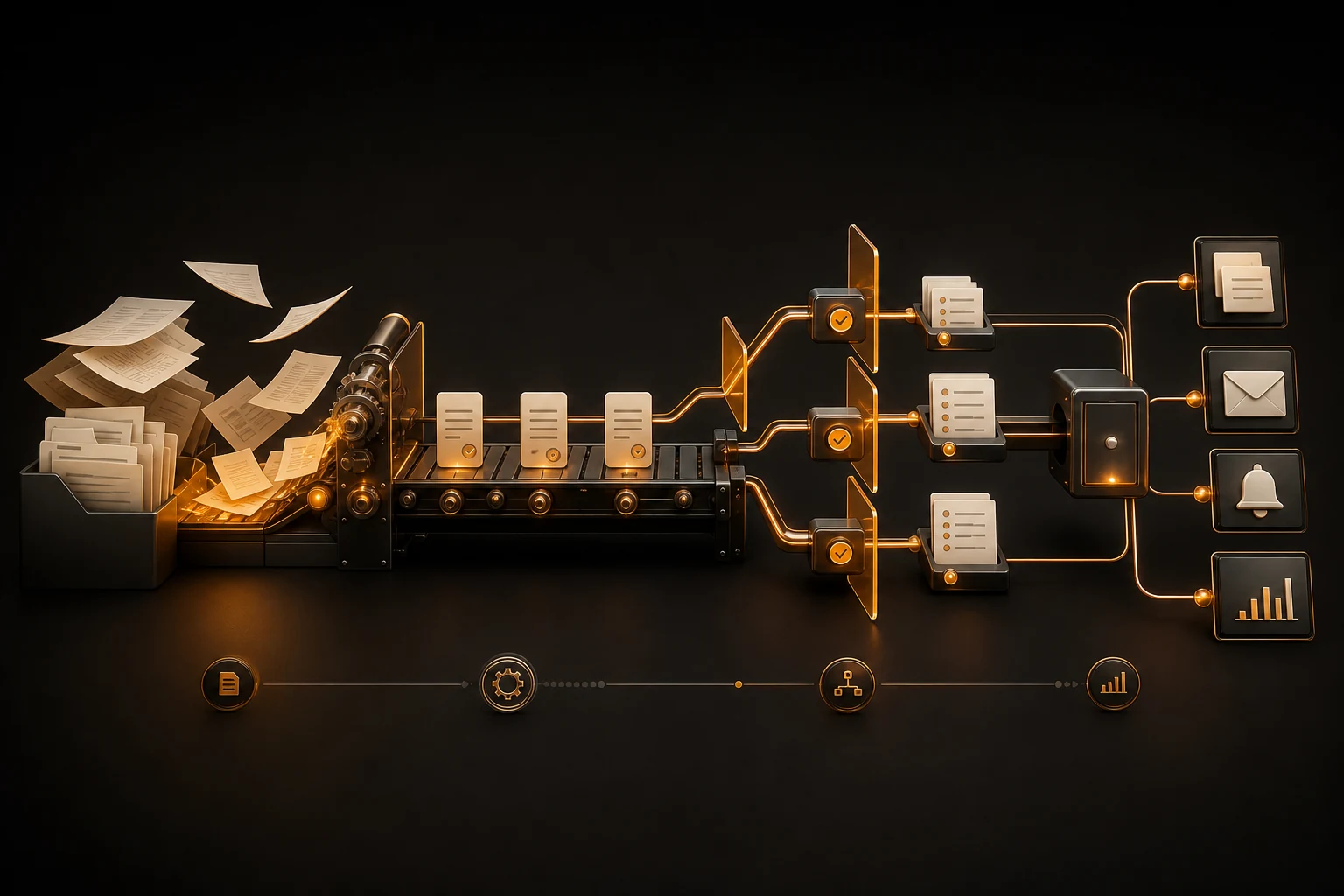
Repetitive work
We map the steps, rules, exceptions and responsibilities before we automate.
We connect existing applications and perform controlled actions for leads, documents, orders, invoices, notifications, approvals and reports.
Automation reduces repetitive operations without hiding errors and eliminating necessary approvals.
Information is moved between Excel, email, CRM and other applications.
Offers, contracts and reports are rebuilt every time.
Decisions and exceptions remain scattered in emails.
Failed steps have no status, alert, or retry procedure.
Who is it suitable for?
Automation is useful when the same activity consumes time, follows verifiable rules, and produces data that can be tracked.
What can we automate?
Collection, validation, distribution and follow-up.
Offers, contracts, PDFs and archiving.
Statuses, documents and notifications.
Responsibilities, deadlines and escalations.
Scheduled consolidation and submission.
Classification and extraction with human verification.
Features and deliverables
We are not automating a fuzzy process. We first define the rules and exceptions.
Limits and Responsibilities
We do not bypass the limitations of platforms or automate critical decisions without the controls established together.
Integrations and mechanisms
Actions and syncs in near real time.
Periodically executed imports, reports and checks.
Controlled processing, replay and duplicate prevention.
CSV, Excel and inboxes, when systems do not offer API.
Technology










Process
For automating a repetitive, clear and well-defined process.
For multiple stages, documents, approvals or systems.
For extensive operational automation and cross-departmental processes.
Estimate
Packages are benchmarks for bounded processes. We don't use a rigid comparison chart because the number of systems, approvals, and error mechanisms change substantially for each automation.
For the analysis we need the current process, sample data, systems, volumes, responsible and the tracked result.
After launch
The stabilization period covers the delivered flow. Continuous monitoring, alerts and subsequent changes are planned separately.
Describes the actual steps and desired outcome. Do not submit passwords, tokens or keys through the form.
Leads, documents, invoices, orders, notifications, approvals, statuses and reports, if rules and exceptions can be clearly defined.
A small and well-defined stream can start from €990 + VAT. Cost depends on steps, systems, exceptions and volume.
Not necessarily. We analyze whether they can be connected via API, webhooks, exports or other allowed methods.
Not always. We retain human approvals and checks where risk or rules require it.
Yes. We can retrieve, validate, distribute and update leads, then send notifications or reminders.
Yes, based on the rules validated by the client. Tax and legal aspects are confirmed by the client's specialists.
Yes. Data can be consolidated, validated and sent at set intervals.
Only where the result can be verified and there are rules for errors, privacy and human intervention.
We define statuses, logs, alerts and indicators such as time saved, error rate and processed volume.
Yes, after mapping steps, systems, exceptions and responsibilities.
We implement, as appropriate, retries, queues, alerts and a retry or intervention procedure.
Yes. Automations must be updated when external processes or services change.
Next step
Describes the current process, applications and exceptions. We tell you what can realistically be automated and at what stage.